Showing posts with label Jack Gilbert (4301). Show all posts

Wednesday, 20 January 2016

Evaluation Question 4

How did you use new technologies in the constructions and research, planning and evaluation stages?


The use of new technology was vital to the construction of my research, planning and my product itself. I had knowledge and experience of some of these technologies which allowed me make the best products possible. The use of new technologies is a key factor in creating media, and therefore for me creating the product through the use of these technologies so they would look modern, professional and realistic.


Planning
In research, the internet was my best resource in terms of the research for all of my products. For example YouTube was very useful as I used it to watch both historical and contemporary music videos like 'Michael Jackson's 'Billie Jean'. This helped supplement my initial research of music videos to identify conventions like titles but more importantly how music video's conformed to Goodwin's theory, for example how women are stereotypically the point of voyeurism from men or how there may be a relationship between lyrics and visuals. I Then watched other videos within the house genre and other electronic dance music e.g. 'My Love' by Route 94 to see the style of house music videos and what i would have liked to achieve with my music video. 

Production

In the construction of our music video, the most significant piece of equipment used was the Canon EOS 650D, allowing me to film in high definition producing sharp and professional footage, enabling us to film in a variety of locations and environments whilst still getting the best quality possible. The camera was versatile and in these different environments we were able to adjust the setting in accordance to the environment we were in; lighting settings.


Settings needed to be changed when filming in the day time and the night time, which was a main feature of our music video.


Final cut was used in the essential stage of post-production, a video editing soft ware which allowed me to use tools allowing me to trim, cut, copy and paste the recorded footage, adding transitions, effects and also music. The vast memory of the Apple Mac's i used allowed me to store vast amounts of footage which made the process easier and allowed us to use the same computer for the whole editing of the video. This helped us in the professional creation of the music video because it had the tools giving us the ability to shape the video the way we wanted.
I have used technology throughout the creation of my product and in the presentation of my evaluation of my product: combining Blogger, Final cut pro, Youtube, Powerpoint and Slideshare and Prezi, Using Powerpoint and uploading my slide onto slideshare, uploading my edited videos from Final cut pro onto Youtube and then all of these onto Blogger.

 -Close ups


                                 Mid shots-


 -Mid shot (Low angle)


Performance shots (high           angle)-


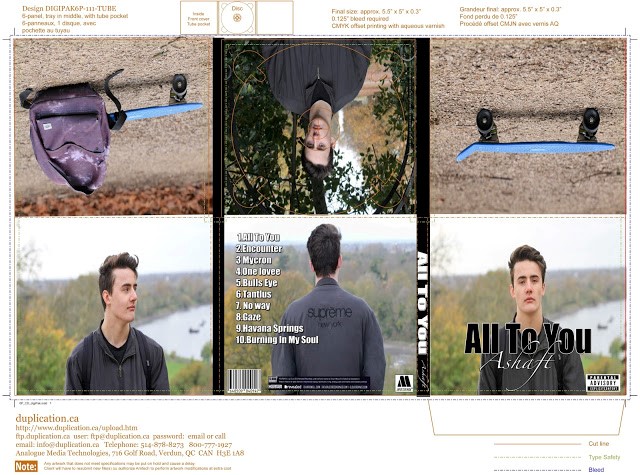
Our magazine advert and our Digipak

We used a Cannon 1100 D to capture the images we needed to create our magazine advert and our digipak. The quality of this camera and the variety of lenses allowed us to capture the highest possible quality photos which were highly professional and in turn made our print products professional. 

We then used the programme Photoshop which was very important in the post production phase. It allowed us to edit, alter and produce a realistic looking magazine advert and digipak; we added a curve to bring out the tones in the image, added a cooling filter then used the tones to bring some of the blueness down, lowered the brightness and added contrast between the brightness and I also duplicated layers and used a spot healing brush to get rid of any imperfections on the protagonists face, all little details coming together to create our final product.


Evaluation

I embedded multiple links into my Blogger, I've captured elements of my produts through screen grabs which enabled me to show in detail, how i created my products and looked into the quality they're captured in.

Through the use of technology i was able to evaluate my products effectively and give others an insight into the research, planning and creation of y Music video, magazine advert and digipak.


Evaluation Question 3


Evaluation question 2

Evaluation question 1

Evaluation Question 1: Jack

In what ways does your media product use, develop or challenge forms and conventions of real media products?


The development of our media products was focused on the House genre, and specifically the use of the song 'All to you' by Ashaft. The house music genre is known to be vibrant and artistic in the way is conveys itself, in recent years gaining huge popularity, its high energy rhythm and beat is extremely popular in both clubs and in the mainstream pop scene while retaining a foothold on underground scenes across the globe. It often focuses on typical flash and dramatic themes, and concentrates on feelings which are portrayed in the chorus, usually conveying a message of love or feeling based around relationships. 


David Zowie's 'House every weekend' is a prime example of House music in recent years. Our music video attempted to mimic key conventions seen in this genre of music whilst developing out own ideas.


We discovered the music videos for this genre of music tended to show less of a narrative, and often random spontaneous dancing or following a certain character experiencing things,they tend not to have many codes and conventions allowing for more freedom when creating the video, they tend to feature themes of love, happiness, sexuality and laughter, things a young audience could relate to. With the producer of the music being a Dj, they are less likely to star in the video itself and therefore either the featuring singer, if there is one, or another individual would step in. 


Genre creates an increased chance of success because by following the codes and conventions, it becomes a formula which allows the audience to develop expectations of what the will be presented with. We conformed to the genre stereotype through using a young attractive male at the age of eighteen. Our music video followed the young man on a 'day in the life' from day to night time which is a common feature in the house music video genre. In the music video for 'House every weekend' people are shown dancing throughout, but attempts to show their highs and lows of their day, with the various characters being tracked from day until night. Our music video conforms and uses conventions of a real media product; we use themes of happiness, laughter, 


Our music video starts slowly and shows the protagonist at his happiest during each chorus/ drop. We attempted to use similar ideas from music videos like 'House every weekend', as an instrumental video for the house music genre scene, we wanted to mimic key conventions.


We also attempted to mimic key themes, conventions and the overall look of the music video; using 'The nights' by Avivii we attempted to mimic close ups of the protagonist, on his adventure and in the studio, a chronological order throughout creating depth as the narrative processes throughout the video capturing the audience's attention as more is revealed and kinetic camera movement and jump cuts to disturb the fluency to the video.


Goodwin’s Theory


In his book ‘Dancing in the distraction factory’ Andrew Goodwin identifies the following features of music videos:
  • There's a relationship between lyrics and the visuals
  • There's a relationship between the music and the visuals, the lyrics  (e.g. sad song with sad lyrics and vice versa)
  • Some music genres may have their own music videos style and iconography (e.g. hip-hop with girls, cars and gold jewelry)
  • There is often a demand for a lot of close-ups of the main artist or vocalist from the record company to establish the artist on screen and identify them with the music
  • Likely to be a reference to voyeurism (notion of looking) usually for females but also in the methods of actually looking (e.g. screens within screens or cameras
  • Likely to be intertextual references either to other music videos (usually to seminal videos) or to films and TV texts


Overall, I feel that when constructing my music video, I didn’t want a stereotypical video that showed teens going out to explore the world, I wanted to represent youth in an opposing way to which they may be represented at this moment in time, a perception of youth now days is connected to drink and drugs, which may be fun for them at the time, but from outside their perspective, others may see this as bad. This may fit with the house genre life, as the people who enjoy this music may live happy and energetic life. I did include Laura Mulvey’s theory of the ‘male gaze’, describing it as characters being ‘bearers of the look’ which is usually aimed at ‘physically desirable’, sexually submissive female characters. I challenged this through using a ‘physically desirable’ male protagonist. Although I did not show off the man’s body, he was given a ‘voyeuristic look’, so was still exposed to the camera, so the audience could gaze at him. I did this through several close up shots, showing off his attractive male features, enjoying himself which may be attractive to people.


Digipak cover

We wanted to reveal the protagonist of the album through the digipak, and therefore reject the house music genre album cover stereotype, as real media products in the house music genre tend to be bright and vibrant, with exotic colours. If they do include images they are of the DJ, voyeuristic images of females or an exotic setting. A recognised font is used for the artist, allowing audiences to recognise the artist and their products, drawing them towards the product.


An example of these digipak conventions; the 'Nobody to love' album cover from Sigma includes a beautiful taken, natural picture of a beach, with two young females walking along it. It completely conforms to the house genre music digipak cover, including a clear artist name, in their recognisable font, and a clear title name. Our digipak cover is similar to this and conforms to the genre in some ways, but breaks other conventions. We also aimed for a natural background, something which may be valued by the youth audience of the music, as often youth see themselves as stewards of nature, and so would be attractive looking. Our young, attractive male protagonist conforms to the conventions of the genre, although he is male and in this sense we revert the stereotype, he is someone who would be found attractive by the opposite sex and therefore conforms to the convention of voyeurism.


Magazine advert

The purpose and basic objectives of a magazine advert are to:
-Promote the artist
-Promote the song
-Be eye catching and memorable
-Be recognizable

Conventions

Album/Song title: My magazine advert conforms to a stereotypical advert as it displays the album title at the top ‘All to you’ in a bold black text used in both the digipak and the magazine advert.
Eminem's Encore uses a similar technique, placing the big bold album title at the top of the advert, with the artist name Eminem underneath.


Record label: My magazine advert does not have a record label as this is usually seen in big artists as they are big enough to be under a company who help sell the artists music, and as our artist is a small DJ, we do not show one on our advert. Jessie J's Who you are is shown to have 'Lava' as it's record label. Jessie J would belong to this label and therefore everything sold to do with her music would have to be labelled by this.


Image of artist: This is not essential in every magazine advert as many artists and albums now feature artwork or simply a symbol. 
My magazine advert is dominated by the main image of the artist, relating him to the song/album and appealing to current fans and 
attracting new audiences. 
Lana Del Rey's Born to die is dominated by the main image of the artist herself. The image is here as they are recognizable by an audience, relating them to the song. This would mostly appeal to current fans of the artist or band but can be useful in attracting a new audience


Release date: This is one of the most important features of a magazine as it tells the audience when the song/album is available for them to purchase or download and be able to listen to. My magazine advert  shows that the album is ‘Out Now’, it is the second largest text on the advert so it is one of the first things you notice after the album title, making it easy to spot and quickly provides the audience with the information that the album is available for them to purchase. On other magazine adverts audiences would also commonly see 'Out now' for smaller marketing campaigns or an average album, but for bigger music albums for bigger artists, who have the money, may have marketing campaigns which advertise the song more than a month before. For example, Justin Beiber's What do you mean was advertised for up to 3 months before the album/ songs release, and became a huge hit, showing the more money and effort put in, the bigger the return.

 By using various celebrities who are popular on and off of social media he was able to countdown the days to the release of the album, creating a huge campaign.


Thursday, 10 December 2015

Day 4 (extra filming)


Editing process

Editing Process

What software do we intend to use for our music video?
We used Final Cut pro to edit our clips to create our music video as we had previous experience of using this editing program and we we find it better to edit on Final Cut pro then any other editing software.
What will this editing software enable us to do?
This editing software will enable us to put together all our clips to create a smooth and professional looking music video like the ones you can find on Vevo. This software will also enable us to link out audio with our clips to make it look like its part of the same thing. 


We overlapped clips and found the best timings in accordance to the music we were using, cutting parts we didn't need. We had over 3 hours of footage, which we cut down to 3 minutes.

What is the likely time scale of the editing process?
Our editing process took us 5 weeks, due to us having to go out and film more footage as we lacked a bit of clips and found out that we needed more footage. This was the main reason for the delay in editing and why it took so long.

Monday, 7 December 2015

PRODUCTION: Filming (Day 3)

Night Filming
Location: National Rail replacement  bus
We began filming at around 4:30/5 in Whitton
The shots taken on the national rail replacement bus were entirely spontaneous. The whole camera crew got onto the bus as a mode of transport to get to Twickenham but we were amazed by the red lighting and thought we just couldn't pass up the opportunity to get some footage. We filmed close ups of Matt as he sat on the bus showing a more livelier side to his character as the story entails him 'coming to life' in the night time. In addition we filmed mid shots of Matt as he sat on the bus looking straight ahead as well as looking out of the bus window.


Location: Twickenham
We once again filmed our tracking shots of the actor as he walked through Twickenham, but also the riverside where we also included some close up shots.We once again filmed our tracking shots of the actor as he walked through Twickenham, but also the riverside where we also included some close up shots. Due to the fact that we were filming when it was dark LED lights were necessary when filming in all of our shots to increase visibility. 

We finished filming at around 7:00

Thursday, 3 December 2015

PRODUCTION: Filming (Day 2: London)

 On our second day of film we too the streets of central London to film our actor. We began filming at around 10:00 after picking up equipment and taking the train to Piccadilly Circus.

Location: Trafalgar Square
These shots were taken by myself outside the National Art Gallery in Trafalgar square, overlooking Nelson's Column. I decided to use this location for close ups, as well as over the shoulder shots, mid-shots in addition to low angle shots to improve the range of shots and angles in our music video. We positioned the actor to stand still and overlook Trafalgar square as it was far more visually interesting to have a blue sky, Nelson's Column and the fountains rather than have him face the Art Gallery building, and it gave the appearance of the character in deep thought.  


Location: Piccadilly Circus
In Piccadilly circus we filmed the electronic billboards on one camera for 10 minutes to be used later in a time lapse. This was useful as it established the location to evidently be in central London. On a second camera we filmed the tracking shots, exploring the city. 


Wednesday, 2 December 2015

PRODUCTION: Filming (Day 1: Richmond)

Range of cameras/ lenses 


1

2
One camera filming our model (during filming), a second camera filmed the time lapses in 2 different areas of richmond to film movement of things like clouds and trees for 20 minutes, then the third camera was used of take stills of the model to be used for our print products. this was an effective system when filming as it made sure that when it came to editing all of our footage and stills were not mixed together, making the editing process far more efficient. Stacio (group member) proved to be a crucial part of the group on the day, providing the third camera, a range of lenses to use, e.g. ones that were better for close ups, distance shots and stills, and he also provided a knowledge base on which lenses to use as he is a photography student.


Stills for Print Products


3

4
Stills for  inside covers
5

6
Here we were able to take stills to be used in the print products for our which included shots of the actor himself with the background (with trees an sky) faded and the shots focused on the character. In addition to this Stacio took stills of the props used within the video (penny board and backpack) to be used on the inside covers of the digipak, using a range of lenses he owned personally to provide higher quality photographs with better focus on objects within a frame.


 Actual filming  - Movement 
7

8
 The majority of our music video is going to be tracking shots of the character, therore the majority of the filming during this day was tracking, whilst the other cameras filmed establishing shots and took stills. Thus simply involved following Matt (actor) throughout different locations for about 10 seconds or more each time, this provided us with a lot of footage so that we weren't limited on things to work with when editing.

Range of locations
9

10
We filmed our actor walking around Richmond hill giving us a range of locations within our shots, stopping a total of 3 times to shoot some stills for our print product. It was important to not only shoot in one specific location as it gave us a range of shots to work with especially when it came to the stills because we had a variety to choose from so we weren't limited if a set of pictures didn't look right on the digipak for example. in terms of the actual footage, the range of locations helped to convey the progression of the story and show the character going about his day.
11

12
By 1:30 the sun had finally come out after a grey morning with a bit of rain. This provided far more natural lighting which was convenient when filming close-ups (as shown in image 12) 


Time lapse: We used one of the cameras to film several videos of locations (e.g. onlooking fields, the sky and buildings) for around 10-20 minutes each. these were to later be used for time lapses in the music video. A problem that occurred  during filming is that we did not have a tripod, therefore we made our own using a penny-board and a camera bag which surpassingly proved to be effective. We have learnt from this mistake and for future days of filming we will always bring at least one tripod for each camera we have.